The ISCN sourced from its network a practical smart city challenge and 8 universities and their student courses from 5 countries and 3 continents responded with more than 40 ideas! The challenge revolved around conceptualizing data reuse to enhance insights stemming from citizen-reporting tools.
In this session of the Global Mixer, Roger Fischer from the Swiss mobility data cooperative POSMO, showed us a different paradigm of binding together challenges of technology, governance and ownership for smart city solutions. What often is but a utopian first sketch, his project is trying to implement in practice.
Key takeaways
Another data world is possible: A cooperative model enables not only strong democratic steering of projects but also grants true ownership for all its members of all their data and the revenues generated by it.
Utility & Privacy as a fundamental trade-off for mobility data: According to research, utility and privacy are inversely correlated. While some claim that this dilemma can ultimately be solved technologically (e.g. through synthetic data), POSMO and others believe in the lever of changing the data environment, rather than the data itself.
Data bias in mobility: The patterns of mobility data that cities currently have access to are skewed towards the car. New forms of data collection can rebalance this to account for pedestrians and cycling.
Faced with all the emerging digital technologies, the individual and society still mostly focus on questions of data collection and data processing to negotiate functionality and privacy.
Roger Fischer, the speaker of this Global Mixer event, on the other hand sensitizes us for the more seldomly discussed questions of ownership and custody of data. For him these are concerns not only because they arguably feedback into the design of digital solutions, but also because in politically volatile times the usual custodians of data may drastically change their way of handling data.
Against this background, he forwards in his talk the model of cooperatives. They have a long tradition in German-speaking countries, particularly also in Switzerland, and are part of the Unesco Intangible Cultural Heritage of Humanity. Cooperatives are voluntary and self-organized associations of people who democratically manage shared interests or resources (commons). The mandatory principle of decision-making in the general assembly is one member, one vote.
In application of this model to the realities of the data economy, Posmo developed a program with which people can track their mobility patterns. In short intervals of 10 seconds, is recorded and AI automatically detects which mode of transport is being used. This is being aggregated into the outputs of distance, duration and carbon emissions of the taken route and mode of transport. In contrast to many other trackers, this happens with full consent and in anonymous form with further usage defined by members of the cooperative and revenues from sales of these data distributed among cooperative members.
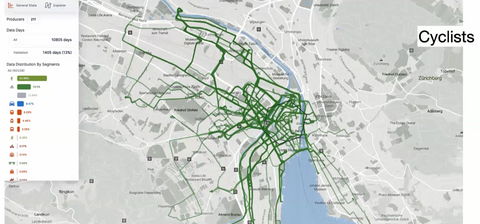
One example that the cooperative thus “produces” is heatmaps of mobility patterns that focus on the often underrepresented pedestrians and cyclists in a city. For the city of Zurich it rebalanced the data fundament of mobility it has since usually such datasets are dominated by data collection on cars.
All this nonwithstanding, Roger was also transparent about the challenges of the cooperative model. He highlighted how it depends on strong dedication of the involved teams, is not as ideal a vehicle to raise money like its competitors, and management processes are often slower due to the coordination needs of their governance, contrasting with the fast pacing of the general data economy.
It is all the more fitting then how he closed with a quote by Elinor Ostrom: “Organizing is a process; an organization is the result of that process”, something certainly true for the building of Smart Cities as well.
See the links below for Posmo’s presentation from the event and other information and enjoy our full recording of the talk above.
Integrated urban development can serve as a cross-sectoral planning concept to manage processes of transformation in urban systems towards sustainability and resilience. At the same time, urban digital twins are being implemented with increasing frequency in urban planning. They can be used to foster such transformations and to make improvements that are more adequate regarding the complexity of urban systems than mere efficiency boost. In this article, the authors discuss how they try to support such change by applying transformative research methods, such as conducting real-world experiments based on prototyping and testing digital tools. The article illustrates how they use the development of urban digital twins in Hamburg, Germany as a field of intervention with the aim of achieving broader usage by and representation of marginalised groups that are typically overlooked in such technology and in urban planning itself.
In this session of the Global Mixer, Roger Fischer from the Swiss mobility data cooperative POSMO, showed us a different paradigm of binding together challenges of technology, governance and ownership for smart city solutions. What often is but a utopian…