Ownership is important: to stay independent of third-party providers or developers, it is essential for cities and communities to own their app
Real open source: The source code of the app is freely available and ready to use
Wide range of features for different use cases: The Smart Village App offers a wide range of functions which allows cities and communities to customize the app to meet their specific needs
The Smart Village App is a comprehensive solution to make information in rural areas more readily available to citizens. The app includes functions such as citizen services, integration of Open Street Maps, news, appointment bookings, etc. Furthermore, it is embedded in an institutional framework allowing for replication with lower barriers and faster procurement processes.
The founder of the Smart Village App, Philipp Wilimzig, presented the app in this episode of the ISCN Global Mixer and highlighted the benefits that using an app as a communication platform can bring to cities and communities, such as easy accessibility through smartphones, direct communication trough push-notifications and location-based services.
One important use case for the Smart Village App is citizen participation. It includes several features that help municipalities stay in touch with their citizens. These range from simple event calendars to digital participation surveys and forum discussions.
According to Philip Wilimzig, the open source approach is key to the success of the Smart Village App. It allows the municipalities to remain independent and avoids vendor lock-in effects. It also leads to more transparency and a verifiable quality. Moreover, it makes it easier for communities to interact and develop new features together.
In this session of the Global Mixer, Roger Fischer from the Swiss mobility data cooperative POSMO, showed us a different paradigm of binding together challenges of technology, governance and ownership for smart city solutions. What often is but a utopian first sketch, his project is trying to implement in practice.
Key takeaways
Another data world is possible: A cooperative model enables not only strong democratic steering of projects but also grants true ownership for all its members of all their data and the revenues generated by it.
Utility & Privacy as a fundamental trade-off for mobility data: According to research, utility and privacy are inversely correlated. While some claim that this dilemma can ultimately be solved technologically (e.g. through synthetic data), POSMO and others believe in the lever of changing the data environment, rather than the data itself.
Data bias in mobility: The patterns of mobility data that cities currently have access to are skewed towards the car. New forms of data collection can rebalance this to account for pedestrians and cycling.
Faced with all the emerging digital technologies, the individual and society still mostly focus on questions of data collection and data processing to negotiate functionality and privacy.
Roger Fischer, the speaker of this Global Mixer event, on the other hand sensitizes us for the more seldomly discussed questions of ownership and custody of data. For him these are concerns not only because they arguably feedback into the design of digital solutions, but also because in politically volatile times the usual custodians of data may drastically change their way of handling data.
Against this background, he forwards in his talk the model of cooperatives. They have a long tradition in German-speaking countries, particularly also in Switzerland, and are part of the Unesco Intangible Cultural Heritage of Humanity. Cooperatives are voluntary and self-organized associations of people who democratically manage shared interests or resources (commons). The mandatory principle of decision-making in the general assembly is one member, one vote.
In application of this model to the realities of the data economy, Posmo developed a program with which people can track their mobility patterns. In short intervals of 10 seconds, is recorded and AI automatically detects which mode of transport is being used. This is being aggregated into the outputs of distance, duration and carbon emissions of the taken route and mode of transport. In contrast to many other trackers, this happens with full consent and in anonymous form with further usage defined by members of the cooperative and revenues from sales of these data distributed among cooperative members.
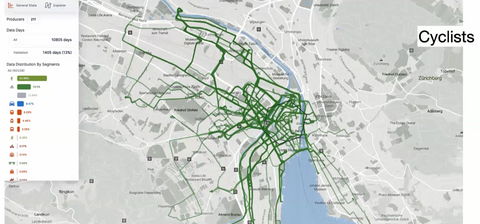
One example that the cooperative thus “produces” is heatmaps of mobility patterns that focus on the often underrepresented pedestrians and cyclists in a city. For the city of Zurich it rebalanced the data fundament of mobility it has since usually such datasets are dominated by data collection on cars.
All this nonwithstanding, Roger was also transparent about the challenges of the cooperative model. He highlighted how it depends on strong dedication of the involved teams, is not as ideal a vehicle to raise money like its competitors, and management processes are often slower due to the coordination needs of their governance, contrasting with the fast pacing of the general data economy.
It is all the more fitting then how he closed with a quote by Elinor Ostrom: “Organizing is a process; an organization is the result of that process”, something certainly true for the building of Smart Cities as well.
See the links below for Posmo’s presentation from the event and other information and enjoy our full recording of the talk above.
How to make the comprehensive experiences in smart city development tangible and portable so that others can take them up easily?
In this ISCN Global Mixer, Dr Beate Ginzel and Elisabeth Breitenstein from Leipzig present their Digital Playbook as a living…
The digital transformation not only affects cities, but also rural areas. There is a particular demand for straightforward solutions to reach citizens and deliver digital services. In this ISCN Global Mixer, Philipp Wilimzig presented an open source app that…
In this session of the Global Mixer, Roger Fischer from the Swiss mobility data cooperative POSMO, showed us a different paradigm of binding together challenges of technology, governance and ownership for smart city solutions. What often is but a utopian…